
willedoo
-
Posts
8,528 -
Joined
-
Last visited
-
Days Won
154
Content Type
Profiles
Forums
Gallery
Downloads
Blogs
Events
Our Shop
Movies
Everything posted by willedoo
-
I might have to stop complaining about my 30% council rate increase last year. I was listening to a grazier speaking on the ABC radio country hour talking about his latest rate bill from the Cassowary Coast Regional Council. He's had a 60% increase this time around. Combined with big increases preceding that, he's now handing over a third of his income to council in rates. Or as he put it another way, for every three cows he sells, one goes to paying rates.
-
onetrack, the last quote is not a totally over the top response, but I wouldn't put it in the respectful and courteous discussion category. When it comes to inappropriate speech on this forum, I'll be the first to put my hand up and admit to it. I've never pretended I don't. But I don't do it to other members because I don't like or agree with the content of their posts. The only time I ark up on someone is as a response to someone making unfounded and ludicrous attacks on me personally. And then I have to slap myself and remember the old Chinese saying that if you argue with a fool, there's two fools arguing. I'm not having a go at anyone here for their personal viewpoints, just calling out the blatant double standards that seem to be the norm on this forum lately. I think everyone on both sides needs to take a chill pill.
-
He certainly hasn't received respectful and courteous replies to his posts, whether they are rants or not. If you did up an abuse balance sheet I don't think long term members score very well on the scale. What ever happened to sensible debate. If people don't think they are getting sensible debate from someone, why just post a reverse rant back. Fair enough if people want to go tit for tat like that, but don't pretend it's just one side doing it.
-
I don't have an opinion on what Brendan has said, but I agree fully with the rest of it. Name calling, playing the man instead of the topic and mudslinging are not the sole domain of new members. For anyone wanting to sugarcoat the behaviour of long term members, just read back through some of the threads.
-
Yes, I remember them being cheap. Solid frames but often had awful Soviet era welds. Factories used to supply free vodka to the workers; maybe the bad welds happened when the vodka ran out. The new Ural Gear Up 2WD outfits start at $35,000 for the standard model.
-
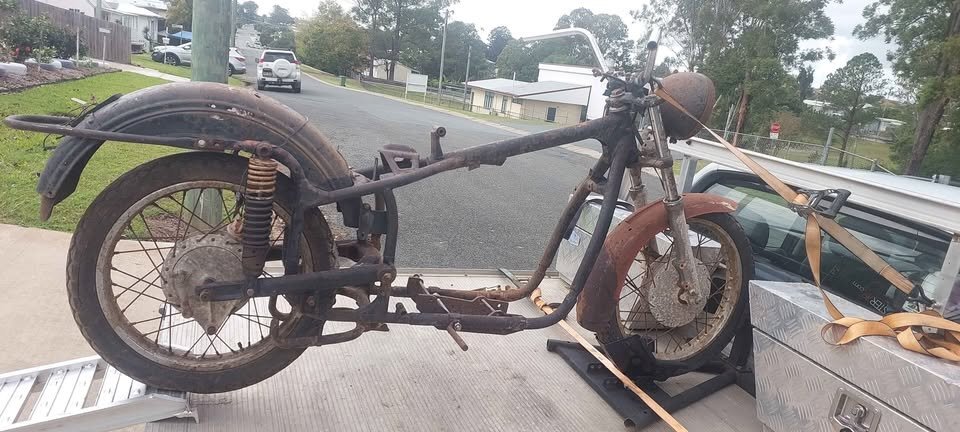
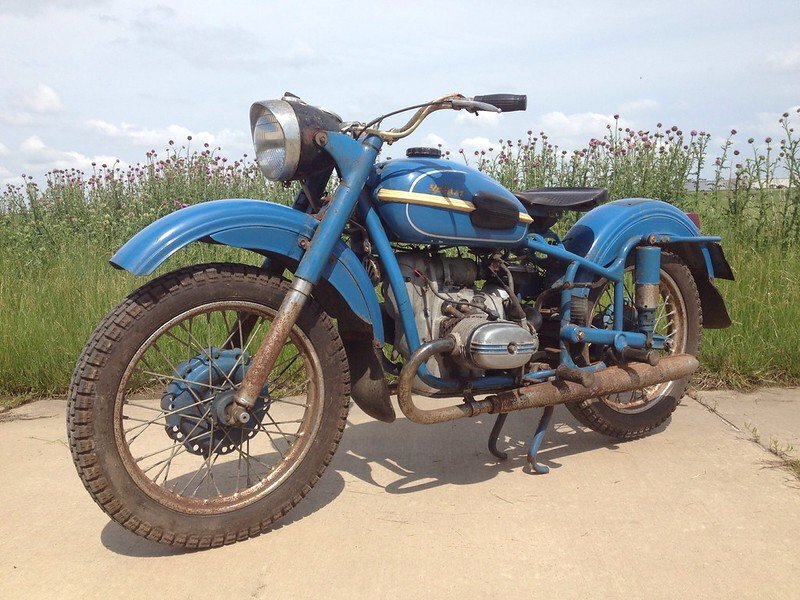
Another new/old toy picked up today, a 1970 Ural M-63 frame. Frame is original from the steering head back, including the rear guard. It also has left hand sidecar mounts which is a bonus. I haven't identified the wheels and forks as yet. The light is an Everwing, probably an old Datsun driving light. The bloke I got it from had only just recently bought it for a Yamaha 500 single motor that was in it. He said the engine was a tight fit in the frame which probably explains why the longitudinal brace below the steering head has been cut out. It's the closest I've been to an old Cossack since 1972. Second photo is what an original looks like for anyone who doesn't know the model.

-
Speaking of common decency: "GON is a fool" "You are a fool GON" "Your a racist turd" Quotes from guess who.
-
The ON surge is understandable in one way and unexplainable in another. Sure, I'm a Queenslander and know well that ON, a Queensland based party, has always done ok in elections in this state for a small party. By ok, I mean polling numbers like 10% compared to much smaller figures in other states. But this time around, I don't know how to put it in words, except to say the shift is major going by what I'm hearing from people everywhere. By that I mean people who haven't voted that way before. If we were six months out from a Federal election, I'd be of the opinion a lot of people still aren't fully aware of what's about to hit on voting day. But we're not six months out and the two major parties have almost two years to turn things around. Not such a hard job for the government as it is for the Liberals; if they don't rebuild to a reasonably solid base in the next twelve months, they're done and dusted for sure. The last year of a three year term is almost like one big long election campaign, so the Libs don't have much time on their hands. They're still sliding down, so they have to halt that before they even have any chance of heading back in the other direction. They're probably looking for a circuit breaker but it's hard for them to get traction when they're still losing supporters and One Nation is dominating the media. If it was newspapers, you'd find mention of the Libs somewhere down the back between the sport and classified ads, while the front page is all about Albo and Pauline.
-
Apologies for quoting just a portion of a sentence, but I'm just commenting on that possibility. For them to gain any effective power I can only see three scenarios. The first and second are assuming Labor can't form a majority at the next election. In that case, One Nation could either be the senior partner in a One Nation/Liberal coalition government, or the junior partner. For the third scenario, Labor holds enough seats to govern in their own right or with the support of independents, but One Nation does well in the Senate and holds the balance of power in the upper house. I don't know whether that's possible or not as I haven't checked how that could happen given there's eight parties and two independents holding senate seats and it will likely be a half senate election if there's no double dissolution. At this stage, while always possible, it's hard to see One Nation gaining enough seats in the lower house to govern in their own right.
-
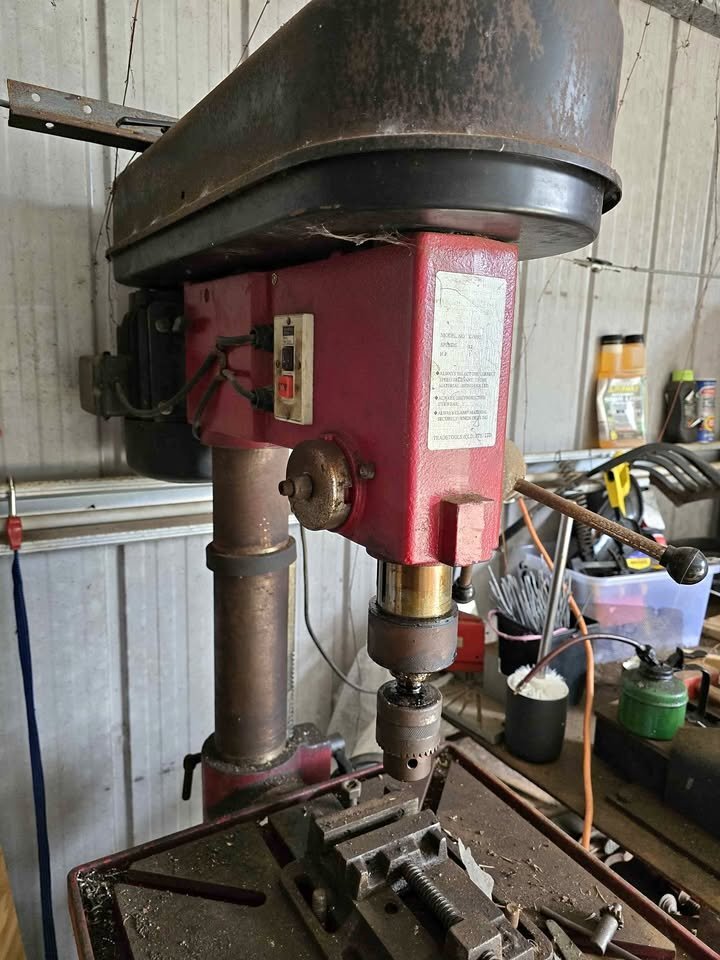
I bought this pedestal drill on marketplace today. It's a bit of a monster, two of us loaded it into the back of the ute, but it must weigh at least 100kg or more. The head is solid cast steel which contributes a lot to the weight, although it's built like a tank from top to bottom. One thing about it though, the on/off switch on the left hand side reminds me of the safety aspect of modern drills with front facing switches. I've got an old bench drill with that same side mount setup and it's not ideal.
-
Don't worry Brendan, it's not your chain I'm jerking. I was expecting a bite from someone else.
-
One Nation seems to be getting a lot of free publicity, some good some bad depending on the media outlets, but the media is certainly giving them some oxygen. It took a shark attack in Sydney to finally bump ON off the top of Google's news feed. It's been saturation level lately.
-
In case anyone is wondering why I clicked the informative button on Brendan's post - I saw the post and he had a string of icons there starting to resemble a poker machine. There was left to right, 1 Like, 1 Haha, 1 Winner and 1 Sad. So I thought why not give him a crack at getting the full jackpot - one of every type, the full string. So come on blokes, don't be mean, all it needs now is 1 Confused, 1 Thanks and 1 Agree. I'm not sure if anyone's ever hit the jackpot on this forum before.
-
I think a lot of the issue nowdays is that almost everything relies on computers. There's humans there but they have to work within their company's systems. Computers don't have common sense and because the human staff have to work within their computer systems, common sense is long gone from corporate customer service. A big portion of the work force these days have never known a day of their life when computers weren't a big part of it, so they don't know any better. To them, ineffective, unproductive computer bureaucracy is the norm.
-
Bumper season that should read.
-
It always amazes me what they can do in that light soil. A cousin of mine farms around 11,000 hectares in the Tammin area and they get into a fair bit of high tech stuff. At that scale a lot of it is about minimising costs so a lot of their decision making is data based. It's another world from where he grew up with black soil metres deep.
-
The main rock around my area is rhyolite. A lot of years ago I had a bloke with a dozer do a slight contour modification, basically pushing off the topsoil, doing a cut and fill then replacing the topsoil. Before he replaced the topsoil, he pointed out some patches of a purple coloured, soft chalky rock that had been exposed. He told me it was rich in minerals and that bananas did really well with it. Turned out he was right. I planted Lady Fingers on that area and they did really well considering the shallow topsoil depth. I fed a lot of flying foxes and bush turkeys on those bananas. The flying foxes weren't too bad; they wouldn't rip the bags apart and would just eat the end bananas on the bunch that they could reach at the bag openings. The turkeys would fly up onto the bags, rip the bags open and peck bits out of every banana on the bunch. They wouldn't eat complete bananas, just destroy the whole bunch by partially eating every single banana.
-
I always thought there was just bunya nuts, but have since found out there's bunya nuts and there's bunya nuts. This year was a bumber season for the nuts in S.E. Queensland with trees bearing well above average crops. A mate of mine lives up on the Darling Downs and recently bought some nuts down from his area that he'd collected. They were noticeably much sweeter than the nuts from my area, and you would think they'd had sugar added to the water, but they hadn't, only salt added. There's a difference in climate that might be part of the equation, but we also have much more acidic soil down here. Where he comes from a lot of the soil is naturally alkaline. I'm wondering whether that's a factor in the taste difference.
-
It would be good if some websites could make the chatbot less intrusive. I guess it depends on your particular device or OS, but on mine the chatbot pop-ups tends to cover content. A bit similar to those retail sites that have continual annoying pop-ups covering content and being an eye distraction just to tell you someone else has just bought something. The problem with it is that if you turn javascript off, the rest of the site loses function.
-
I've only ever known one bloke in that category. He never knew what party was in power state or federally, and could never once in his life name who the PM was. He used to go along every election and vote Labor. He was a funny character, he had cut a couple of holes in his beanie to use it as a teapot warmer. When he'd finished the pot of tea, he'd take it off the teapot and have a nice warm beanie to put on his head.
-
Marty, you do know that I was joking, don't you?
-
I still think our system here takes a lot of beating. A constitutional monachy with the best of both worlds. No el presidente, all government members are elected, not mates appointed by a president, and we have an elected senate, no unelected house of lords. Having an admittedly quirky, but harmless wingnut in pommieland as our theoretical head of state is a small price to pay for it.
-
I got an email from my power retailer today outlining the new pricing. The daily supply charge has increased to the tune of an extra $180 per year. The tariff rate for useage has decreased by 7.27 cents per kWh. At my average useage, that will be about $167 less per year, so the net result is $13 p.a. worse off, no big deal. My useage is about half that of an average household, so an average household would be better off under the new price structure by at least $150 per year.
-
It could very well represent TonyAbbott Derangement Syndrome. I know someone who's got a severe case of that.
-
That last sentence should read rational. not rationl. That sticky 'a' key has been bugging me for a while now.