
Jerry_Atrick
-
Posts
8,958 -
Joined
-
Last visited
-
Days Won
83
Content Type
Profiles
Forums
Gallery
Downloads
Blogs
Events
Our Shop
Movies
Everything posted by Jerry_Atrick
-
It's hardly fixing potholes: https://www.abc.net.au/news/2026-08-31/victorian-prisoners-to-work-on-road-maintenance/107096380 And it's hardly using chain gangs
-
I think you'll find they get their information from their bank account and what is left in them after the bills are paid.. or their crumbling health services, etc. Murdich makes it easy ti fund someone to blame and someone to use to punish the incumbents. Look over here.. a PM who finally gets it and with really tiny tweaks, the protest party, Reform and his mates are imploding in the polls
-
It is depressing but the reality is the incumbents won't change unless it is forced on them.. And there appears only one way they will get it.
-

The climate change debate continues.
Jerry_Atrick replied to Phil Perry's topic in Science and Technology
Count Binface, a satirical candidate in the Clacton by-election included in his policies requiring anyone who denies human-caused climate change to return to school. Quite frankly, I would have voted for him if he was in my electorate on that alone. The Australian death toll from the Nepal disaster alone - which is hard not to ague was the result of climate change - was 46. Stuff will get worse.. My favourite saying is facts don't give a ship about what people think. -
This post is an exemplary representation of the way many voters feel today. It is no use arguing with the post or the reasoning because the post isn't arguing for anything better, worse of different than we have today. It's a recognition that the average person is squeezed and those in power are not putting the people first. There is nothing in the post to say ON will be any better.. it is about punishing those in power who are ignoring the people - plain and simple. For a stereotypical family, both parents are working and struggling to make ends meet when in yesteryear that wasn't the case as much as it is today. There are structural reasons for it.. modern life is more complicated. It is useless a polly saying don#t have your avocado toast, because it makes little difference in the end. You're lifestyle today is busier. People are working longer hours or when in the office travelling longer to get there and back. Many people when they get back do some form of work where that was rarer in previous generations. So, they are time poor and it is less of a luxury and more of a necessity - unless you want them to eat unhealthy processed food and eventually put more pressure on an ailing public health system. Ad don the need for smart phones for virtually all the family as you just can't do some things without them these days (or it costs you a lot more), tolls, longer hours, after school activities, child care for younger ones. And to help with a far more complex family life than in my day, it costs the government more. What people don't realise is the government has little levers to pull to manage the cost of living unless it starts taking measures that people will then complain of government overreach. So in some respects, they're damned if they do and damned if they don't. To make things cheaper for example, we need denser housing because Australia suffers from diseconomies of scale. A land mass the size of the USA and 1/10th of the population. The more land with the fewer people, the more it costs to get services - especially those requiring infrastructure - to the people. So when the incumbents start to take things for granted - such as a vote - and let's face it even Labor is being a little less conspicuous in that taking for granted, people get pissed off because they can see the parties working for vested interests of the few - and themselves - and not at least trying to make decisions that are better for the people at the same time - like finding a balance. The gas excise issue is hotting up and people are now well educated on how Australia is being fleeced. This is a deal I think penned in the Howard years, but it can be fixed. The ALP consistently refuse to do it. That would add if I remember rightly $16bn to the coffers per year. You could solve quite some issues with that. The persistent morally corrupt lack of support for veterans; the Robodebt royal commission has not resulted in any meaningful change. The gambling ads report has not been implemented at all; Upping the public take of the pokies and other gambling is not being done. Approving fossil fuel leases/mining when there is clear majority opposition to it - and these never result in the promised jobs for locals; And then there was a recent bailing out of a mine or something... when was it Woodside or BHP (can't remember which one) are making massive profits?? WTF. In the last administration, they threw away a nascent market advantage by going for an early transition of energy (Yes, Siso, I know you don't approve). It wasn't until it was clear that SFM was going to lose the election and backing fossil fuel companies was costing him big time did he do a back flip. The above post says we have had enough of being fleeced. We want to send a signal to the incumbents that just because they may be the better, it is of a pretty bad bunch.. and we don't care if the next ones are worse, because until you get it through your thick brains that we are onto you, we are happy to vote in the next bunch of idiots, because in reality, for us, it will make little difference in the end... I don't think they believe ON will be any better.. they may use it to justify their actions, but when inaction is so poor with the incumbents, I agree wit the post - ignore the people and you're done for. This is exactly what is happening in the UK until Reform shot themselves in the foot; and it is exactly what happened in the USA (with the help of a media hell bent on getting an outcome for its advertisers regardless of the impact on the country). I think it is what is happening throughout Europe. People are sick of the same ol' same ol'. May as well make life hard for the "establishment".
-
Content and Providers Worth Sharing(Not Political)
Jerry_Atrick replied to Jerry_Atrick's topic in General Discussion
This is a great vid.. And if they keep doing this, I will be on it: -
Sadly,, not.. The tested it for about 10 minutes, and the new regulator burned out. This is consistent with what happened in my case.. I was getting positive charge, and then nothing. One lives and learns, I guess. The shop put it back on their bench regulator, and it is no longer charging like it was... They are thinking one of tow things.. the stator is, once it warms up, over exerting itself or there is a short in the electrical system. We are on a bank (public service) holiday weekend, so no one will look at it until Tuesday. F! I am in three minds now... Sell it.. I will still get about £1200 for it, because apart from this issue, it is in bloody good condition and it is a superb riding bike. But, I would have to buy another... And yes, a BMW is not out of the equation... Let the shop diagnose this issue. At the moment, their theory is the stator is surging.. they will inspect it on Tuesday anyway. But if that is not the issue, then there is a short somewhere, likely in the loom or some ancillary wiring - less likely.. Just get them to replace the loom and ancillary wiring. A new loom is is about £130.. Actually, at the same time, upgrade the stator, which is about £200. The issue on those CBFs is the flywheel behind the stator doesn't allow enough oil flow to cool it properly, but the fix for that, unles syou can find the right flywheel at a breaker (wrecker) is £500 for the part alone. I am thinking number 3.. But.. Number 1 may come into play - because the same shop have a tidy used NT1100.. but that would mean about £6K that could be better spent on finishing the main money pit (house).
-
I had a random thought today about @old man emu - happy wildcard round today. I can't say I would ever support a team who until the constitution of the AFL had the zone to build and the sponsorship of the old money to buy premierships, but the turnaround when they finally allowed someone who could coach to coach has been great to watch. If only because despite the old money that still flows to the club, they couldn't normally manage their way out of a paper bag... I know my team are punching well above their weight and expect them to fall in straight sets.. so, unbelievably, I find myself wishing the Blues the best for the finals. . . . . . . I thought I would add - Wolfie has returned (well, it is Mr. Wynns actually).
-
If ON get in, for some, yes.. For most, including - dare I say it - yourself, no, unless you want to be worse off than you are now. Regardless of the outcome, the differential between the primary vote should be a very star wake up call to both Albo and the LNP. And it is not a wake up call to lurch to the far right.. it is a wake up call no one can take votes for granted anymore. Over here, admittedly with a press dead against him, but a purely technocratic apprach, Starmer conceded a lot of ground to Reform and Restore (the breakaway part of Reform - both as bad as each other). Like Albo, his management of the economy and social cohesion was better than his peers and certainly very good given the constraints he faced compared to Albo. Yet his continual pursuit of economic prudence within constraints they had to promise less the press during the election campaign would have hung, drawn, and quartered them for at the cost of the middle and lower class population. Their attack on the vulnerable to appease the right wing press was duly castigated by the right wing press (well all of the press). And with each prudent move to save in relative terms, a pittance, was met with abhorrence from even his most ardent supporters. He is no longer, Burnham talks the talk and has taken small steps, and suddenly the protest vote Reform is, had tanked.. Burnham in the polls is by far the preferred leader.. If the Tories can sort themselves out, they will depose of Reform altogether. And you know he has got something right by at least talking about looking after the masses, as even the right wing MSM have stopped calling for a general election as he was not elected as leader for the prime ministership. Albo is better than Starmer, and has turned out better than I thought he would.. I will concede that. In fact, I would generally say he has been a good PM for Australia. He has proven that immigration is not the issue when it comes to property prices (purchasing at least). And despite everyone in the real estate industry saying rental properties will decrease and rents will go up (they have been anyway - at the same time house prices have been which is considered an economic inversion) there appears to be signs investors are returning to the market - with lower prices for the houses because their yield calculations have changed. However, the ratio of home buyers v. residential investment property buyers has definitely shifted in favour of the former, so the house prices will return to some semblance of normality. I will give Albo super credit - it took guts because a lot of recent home buyers are now in negative equity - investors and residential purchasers alike. My advice to wither is if you are not under some mortgage contract to top up a margin (and some will be), then, as long as you can make the payment, stay put. For both of you, the investment is long term. OK, if you just bought a one bedroom place and the wife is pregnant, this will prove a challenge.. and if you are into negative equity territory, this will be devastating. My first born in London was in the same position (although - at least until the money I have sunk into this place - I have never been in negative equity) where if I sold, I would not have had much to show for in in moving up the property ladder. You may have to have the cot in the corner of your bedroom or stick it in the living room.. You will get through it.. and if you hang out, you will make money.. but at the same time your brothers and sisters will also be able to put a roof over their and their newborn's heads. But the reality is, everyone today wants immediate results. So there are other things Albo can do immediately. The Gas Excise (those calling for 25% is too low in my estimation); reforming the tax take so things like funds transfer are mitigated, etc.. pouring money into people rather than foreign corporations, direecting the spend to stimulate Aussie owned innovation, etc etc.. These are not huge things to do.. but will go much further than the sponsorship the ALP (and LNP) gets now. Until he (and Angus) address that, Pauline - who I have to say - I admire her tenacity - will get a look in.. And I believe Clive sees an opportunity and is preapring for another tilt. @Grumpy Old Nasho - should PHON get in, I hope you have a significant amount of cash stashed.. because there is very little she really offers that will do anything but make life more difficult for you..
-
that i something I would believe.. though I am not sure they can produce it at the intensity of the players - though I am guessing there would be some relative to body size that would bring it closer than we (or I) think. I recall in year 8, Jack Leahy - my then English teacher - was telling us about an experiment where a bunch of toddlers/early walkers were put in a room behind one-way mirrored glass with a bunch of toys (those plastic type cars, balls, etc), and a bunch of relatively fit adults on the other side of the glass with the same sort of toys (obviously where necessary increased in size for the stature of the adults) and the adults had to mimic/copy everything their assigned toddler did throughout the day.. By the end of the day, apparently the toddlers were still more or less going strong, but the adults were completely stuffed. Of course, when the toddlers slept, the adults could only rest - but apparently some did fall asleep during those breaks, too. I have no idea if it is true or not, but he was one of the best teachers I had, so I have no reason to doubt him.
-
OK, I am going to show my workings now, because I obviously, got one of my sums wrong in the penultimate question. Assumption: Despite appearances, this is not an equilateral triangle and despite the absence of the degree symbol, the 3x's and 4x denotes degrees of the inner angles of the triangle. As the inner angles of any triangle always add up to 180 degrees (I am sure there is some theorem that disproves this), then 3x + 4x + 3x = 180; therefore 10x equals 180. Therefore, x equals 18. The angle of y is the difference between 180 (straight line) and 3x, or 3 x 18 or 54. 180 degrees take away 54 degrees = 136 degrees.. Oh wait.. that is where i went wrong in the last one.. it is 124 degrees.. Darn it.. I have been working with computers for too long! Think about this.. if I got this wrong, and I am involved in implementing market risk systems, which are quite mathematical, what hope has the global economy got?
-
That would be correctly named "Swamp"
-
pfft! This is the money pit. I have stopped counting how much I am putting into it as it will just depress me (and it has eaten into reserves already). Latest is on my return from Aus, I went straight to work .. partner calls in a panic - power put... Sparky called.. Whole basement had to be rewired... All work stopped for a week as power required for a lot of what was going on.. Thought it was going to be £7K, but "Happy" mates rates brought it down to £4k. Current builder spent 7 hours in last two weeks as he had a roofing issue at his own house. A decorator started today. This is the longest finals to landing I have ever been on.
-
I think its 150, but could be 170. Geometry and trigonometry were never my strong points (pardon the pun).
-
Normally, I go for function over form 😉 Normally.. Can't say I have had that much function on the current bike. 😞 I would mandate everyone has to learn to ride a proper motorcycle before they can touch a car. Can I have your vote now?
-
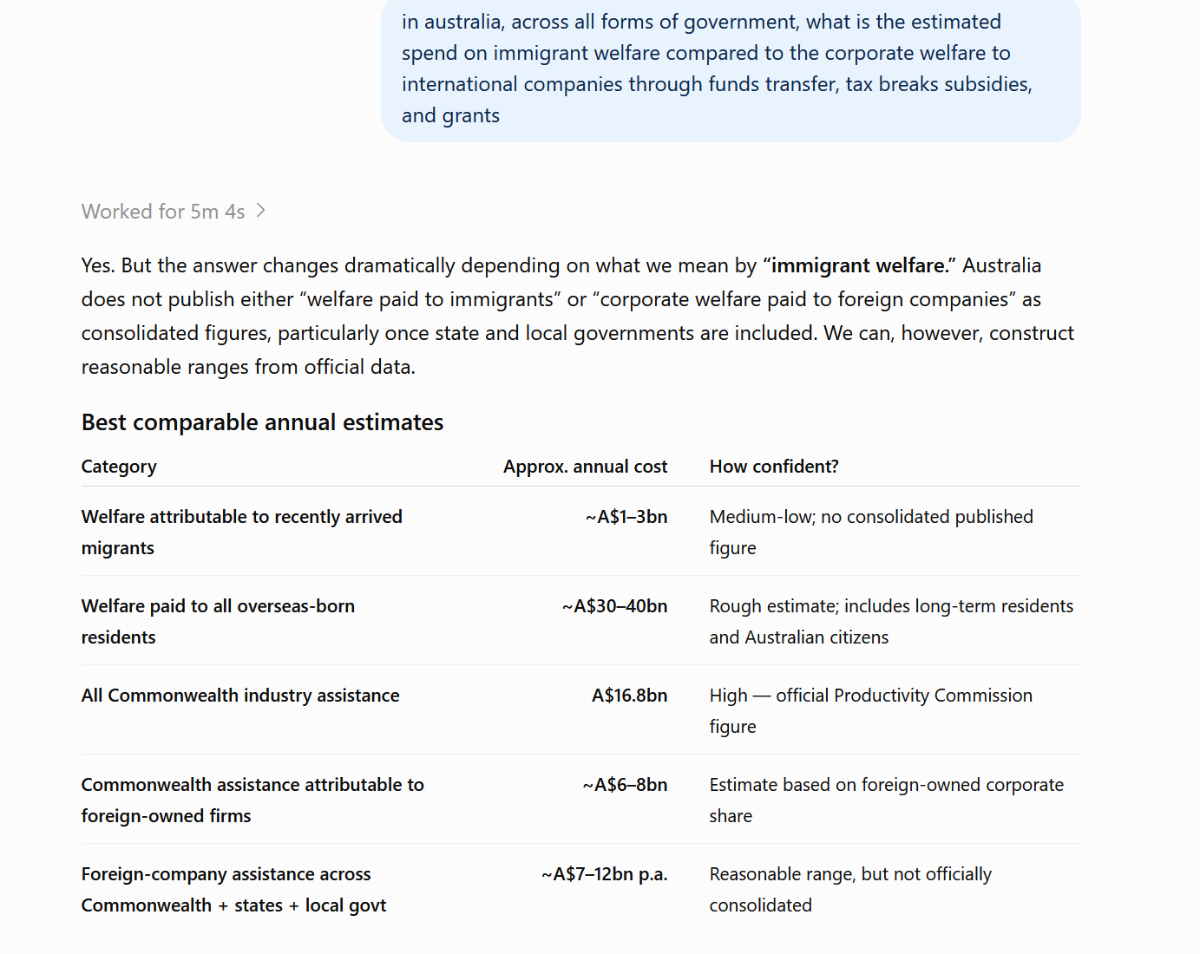
I actually don't disagree with some of the sentiment above. But picking on immigrants is not going to solve the problem. In fact, foreign corporations welfare - so to be clear - lining the pockets of foreign shareholders - using things like tax breaks, grants, subsidies, and funds transfer (legal avoidance of tax). That is a lot to research, so I thought I would use some water and get AI to do it. Here is the summary - and its confidence in each number (a nice trick - I wished people would use this when quoting facts - maybe AI has some advantages): For transparency, I included my response and its initial response. And here is a link to its hole answer https://chatgpt.com/share/6a907746-4178-83eb-a04f-be64bfef4444 We have to take the second line of the summary above out of the equation because that includes pensioners and longer term immigrants, and to properly account for that, we would have to measure the input into the economy and deduct that from the $30 - $40bn per year. For the sake of argument though, let's assume that it is the same as recently arrived immigrants, at around $3bn a year. So, the total in welfare attributable to immigrants is say $6bn a year. The confidence in that figure is low. So lets more than triple it to $10bn a year. That should be more than what it is, but since some here have expressed a dissatisfaction with lefties cooking the books, lets err on the side of caution. Lets only take the bottom line (pardon the pun) as all of government assistance to foreign firms and assume the second from the bottom like is for some reason singling out the commonwealth portion. It is a reasonable range guess. On the low side, it is below the adjustment for error in the immigration cost, and on the high side, it exceeds it. I would guess there are far fewer foreign corporations, so the amount paid per "head" will be a lot higher. Of course, if we assume the numbers provided are near accurate, which in their own words are of low confidence, corporate welfare is costing between 4 and 7 times immigrant welfare - every year. That adds up. Of course, you could argue that corporate welfare provides jobs. Yes it does, but why give it to foreign corporations? Why not give it to Aussie owned corporations and use it to build up Aussie industry and Aussie assets? Also, welfare to immigrants is spent locally. There is none sent back as profits to foreign peoiple (yes, some immigrants do send money to their families from their homeland - but they will by far mostly be those working and not given "handouts"). Thinking about it.. I do agree with the meme. Get the immigrant corporations out and get Aussie ones in their place.

-
BTW, if you really want to stop the rent takers of the economy, start using cash for as many purchases as possible. Every card transaction - and I do mean every one - results with some going to one of two payments companies in the US. Even our dear eftpos has to pay a fee.
-
Although largely correct, my understanding of stablecoin is that it has to be backed by a liquid asset to derive its value. In other words, we would treat it as a derivative financial instrument when pricing it. I am not sure how the inversion of the dollar value would send the stablecoin up in value. It effectively becomes a proxy for directly buying US Treasuries in this case. There is no mandate for a stable coin to buy anything.. but on issuing more of the currency the stablecoin can do one of two things.. not buy any, which will dilute the value of the already issued coin as well as that of the newly issued coin, or top up their reserves of whatever is backing the stablecoin - in this case US Treasuries. These holding represent hedges against the loss of value of the coin against the currency they are stabilised against. Importantly, they don't have to buy up new US Treasuries (or whatever currency they are stabilised against), and they don't have to buy the debt - they can hold cash reserves - though that is far more expensive. I am nto sure about the retail market, but any intitutional interest in a properly hedged stablecoin as a result of a decrease in the demand of the asset backing it would not lead to an increase in demand.. In fact, it would go the other way. In the above case, if they saw the dollar dropping, they would probably take short positions in that coin (note, assuming this is not speculative) because even if it took a while for the hype of the retail investors in the coin to wear down, the coin would drop to its actual value... Also, for the coin to remain a stablecoin, as it dfoes not have cash as a hedge, it would likely have to buy more US Treasuries to maintain its stable status, and that could squeeze its finances and eventually cause it to break from the claim of stablecoin, which would then kill demand and value as it becomes another meme coin after that, or go into massive debt to hold its value. If the dollar stayed long term depressed, either way, the coin will eventually go with it from a retail investor perspective. That is my favourite. Errr.. Yes they did.. They knew tariffs were coming, and from his first stint in office, they knew he was going to be a lying, corrupt con artist. The fact this bit was not in his policy did not mean he wasn't going to try to use the presidency to disproportionately enrich himself corruptly. It could have been any myriad of ways to do it.. And yes, you just had to listen to his policy speeches (rallies) and realise he was all about tanking the US economy through increased debt and tariffs, and being a dictator. It seems that people are really no smarter than any other animal - you offer them a morsel of bait with a giant hook in it, they will not see the hook and just take the bait, hook, line, and sinker (in fact, some animals seem smarter as when they see the hook, they nibble at the bait but not take the hook). And then they will start thrashing about trying to get off the hook as they are drawn to the usually inevitable conclusion. In the aftermath of the initial policy implementations, it was educating to see how many people who voted for Chump say they didn't vote for the policies he implemented - the very same policies he was very clear about implementing before the election... Teachers voted for slashes to the education budget, government workers voted for DOGE, undocumented immigrant families voted for ICE.. those on SNAP having it withdrawn, and the list goes on. It was absolutely mind boggling when they would turn up on youtube and MSM and say they didn't vote for that... What they thought for some reason is it wouldn't happen to them.. when it was clear it would. And the funny thing was they often said they would still vote for him... They are getting exactly what they voted for.
-
Although to smaller extents, there are a few more countries I could think of that could fit that bill.
-
80 doesn't seem to be a good number for celebrities this month
-
I am sure Iran will happily purse Chump himself, but apparently, there is now a bounty of his son, Baron.. so he has succeeded in drawing his own kid into the line of fire: https://www.independent.co.uk/news/world/americas/us-politics/barron-trump-threat-iran-bounty-war-b3038679.html I bet whichever of his wives is Baron's mum is ecstatic at the idea.
-
Think of all that GST they can reclaim without a penny of revenue?
-
As with everything, ultimately the consumer and more broadly, the general population ends up carrying the costs
-
Dolly Parton has passed away aged 80.. in very long article on the ABC news website, it only mentioned health issues. SWMBO will be devastated