
octave
-
Posts
4,381 -
Joined
-
Last visited
-
Days Won
58
Content Type
Profiles
Forums
Gallery
Downloads
Blogs
Events
Our Shop
Movies
Everything posted by octave
-
Yep. We are going to visit him in a few weeks (in NZ) and he always lends us a car. I am thinking this time I take the other car.
-
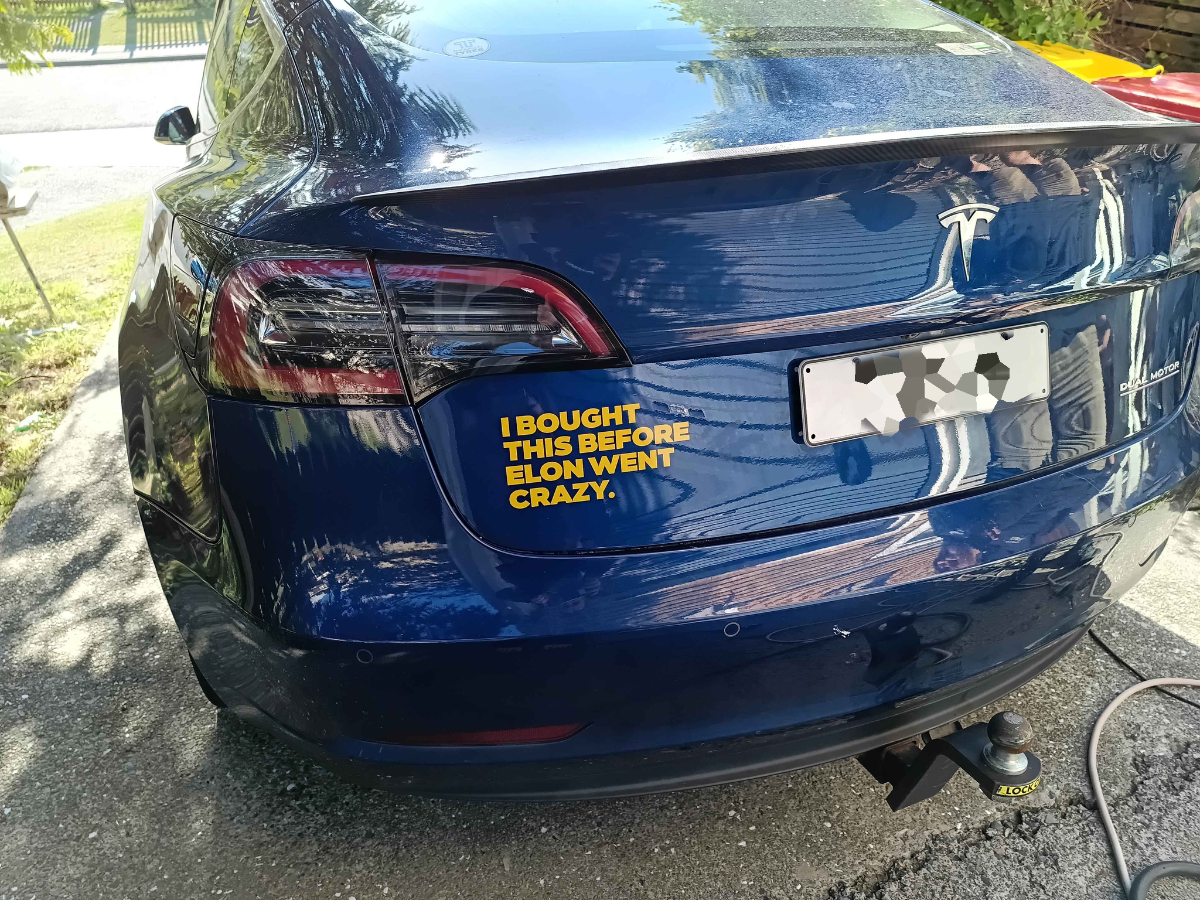
Here is a picture of a modification my son made to his car. I was amused when he said it had lost value because of "heil damage"

-
and yet votes for major parties are declining and for minor parties increasing. The steady decline of voters choosing the major parties is reshaping Australian politics Over the past 40 years the share of votes going to independents and minor parties has risen in both state and federal elections. Seismic shift’ from major parties defines 2022 election Almost one in three voters cast their ballot for minor parties or independent candidates in the 2022 federal election, the highest number in almost 100 years, Australia's largest and longest-running study on elections has found. If the AEC is favouring the ALP and Coalition it does not seem to be paying off for them.
-
I am not trying to be mean but trust me, you don't understand how preferential voting works
-
Yes because of course Trump doesn't use disparaging language about anyone else. For a man who happily insults others he sure does have a thin skin but this is the hallmark of a malignant narcissist.
-
It went up because of it's US operations as in the portion of it's business situated in the US. Its US operation may benefit from tariffs but is Australian operation won't While BlueScope is best known in Australia for its Port Kembla steelworks, south of Sydney, the company generates more revenue from its North American operations than in Australia, according to its most recent financials. It has a large presence in Ohio, and could therefore end up a beneficiary of a tariff regime that hinders rivals. Its shares were up 4% earlier on Monday, in response to Trump’s announcement. A BlueScope spokesperson said the company would “continue to work with the Trump administration and the Australian government, as we await further details”. Steel fabricator Bisalloy did not fare so well on Monday morning, with its shares falling 4% in early trading. The benchmark S&P/ASX 200 was down 0.25% by late morning, tracking a sell-off on Wall Street on Friday. The tariff announcement likely created further uncertainty for traders, weighing on overall market sentiment.
-
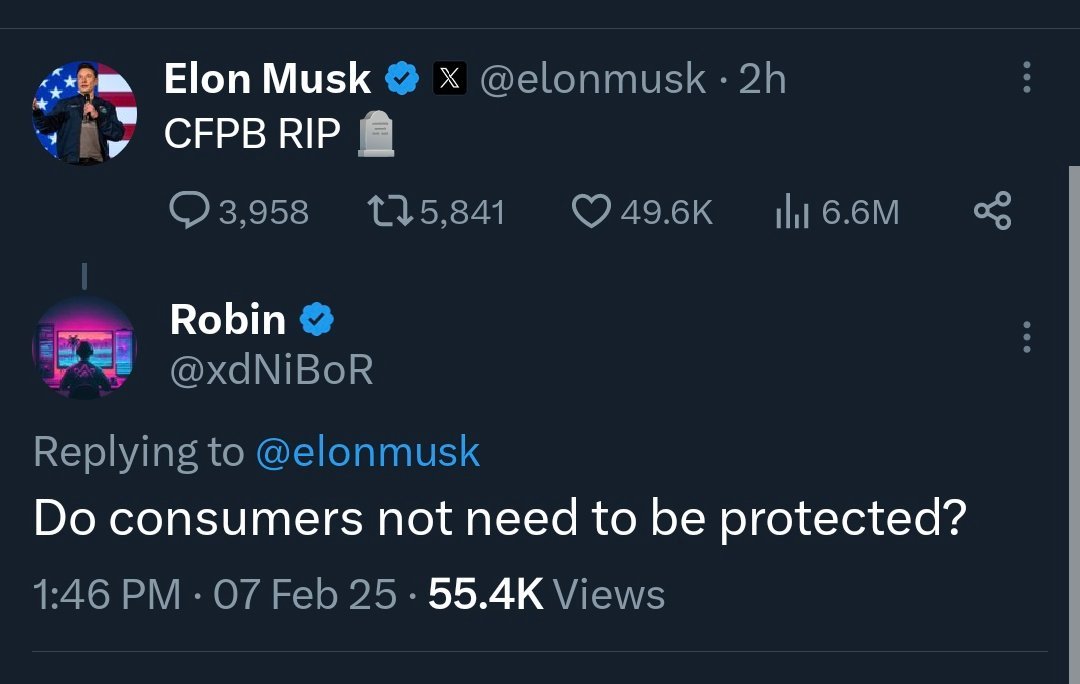
So Musk and rumps latest "kill" is the Consumer Financial Protection Bureau. From its creation until 2017, the CFPB "has curtailed abusive debt collection practices, reformed mortgage lending, publicized and investigated hundreds of thousands of complaints from aggrieved customers of financial institutions, and extracted nearly $12 billion for 29 million consumers in refunds and canceled debts."[41] That figure had risen to $19 billion by 2024.[42] Consumer Financial Protection Bureau I am not saying that it should not be immune from cost-cutting however it seems to me that a billionaire, who can, afford to sue a bank if they are wronged, probably does not appreciate the importance of this organisation to ordinary people who might find themselves wronged by a bank. The running cost of this department seems to be about 500 million a year,(2021) but it has returned 19 billion dollars to consumers in 7 years. Musk is taking a chainsaw to something that he perhaps cannot see the purpose of but this is because of his extreme wealth.
-
Consumer Financial Protection Bureau virtually shut down as DOGE, Russ Vought take over The Consumer Financial Protection Bureau (CFPB) -- the government watchdog charged with safeguarding American consumers’ finances -- has come to a virtual standstill Saturday night, according to an internal email obtained by ABC News. The email sent late Saturday night directs all CFPB staff to "cease all supervision and examination activity" and "cease all stakeholder engagement" effective immediately. The agency’s website shows an error message and its X account was also taken down. The email was sent by Russell Vought, the newly confirmed director of the Office of Management and Budget, who is also now the acting director of the CFPB. Vought was an architect of "Project 2025."
-
Yep Trump’s Buyout Offers Backfire As Federal Workers View It As A “Scam”
-
Well well, it turns out that USAIDs inspector general was in investigating USAIDs public/private partnership with Musk/SpaceX arrangement for supplying Starlink services to Ukraine. This surely has to be suspicious or at least a conflict of interest. See video (relevant part starts at 5:37) Also FAA fines SpaceX $600 000. Interesting that the head of the FAA "resigned"
-
'A lot of garbage': Fmr. Republican USAID administrator slams Musk and Trump for gutting agency The thing that Trump and his followers do not seem to appreciate is that providing aid to a third-world country is not just about a wealthy country lending a hand to a poorer country but also about self-interest. Helping an African country with an Ebola outbreak is better than that disease spreading to the US. Australia provides aid to the South Pacific partly because the Chinese wish to endear themselves to the people of this region. It is called soft power. Trump is entitled to change things however it has to be within the law (which it is not) and it is mind-numbingly dumb to go in with a sledgehammer and destroy everything. If I have a medical problem I want the help of a surgeon wielding a scalpel with care not a moron with a chainsaw.
-
The BBC has two corporate charities. Children in Need is our UK-based charity which provides grants to thousands of projects which focus on children and young people who are disadvantaged throughout the UK. BBC Media Action is our international development charity. It makes TV, radio and multimedia content, and mentors journalists and broadcasters to help people in some of the poorest parts of the world. So which part do you object to? the Children in need or the mentoring journalism in the poorest part of the world Perhaps you should be paying more interest in what Elon and his DOGE teenagers are up to. For a start, there is a massive conflict of interest. Elon and his techno bros have been given access to an extremely sensitive database. Elon is the recipient of huge amounts of money from the government (Space x Telsa etc) He likely has access to information about his competitors. This is a conflict of interest. His band of techno boys don't even have appropriate clearances.
-
Trump and Musk Promote Misleading ‘Scandal’ About Government Funding Media
-
So is that was this buffoonery is about, is it actually a cunning plan?
-
I just heard a line in a video analysing Trump's tariff policy that made me laugh. It referred to the tariff policy from the US perspective as "stop or I'll shoot myself in the foot"
-
Many new cars removed from sale over new design rules
octave replied to red750's topic in Auto Discussions
Sounds good to me 😃 Michael Pachota, Suzuki Australia general manager, said the brand is set to significantly change its model range over the next 12 months. “We’re clearing the way for new technologies; Suzuki Australia’s hybrid and electric journey starts now,” he said. -
Yep, it is a lie however his sycophantic followers believe it. Banks are not allowed to do business in Canada -YES THEY ARE AND THEY DO. Fact check: Trump falsely claims Canada prohibits US banks Daniel Dale By Daniel Dale, CNN Trump falsely says U.S. banks aren't allowed to do business in Canada. What does he mean? Trump wrong, U.S. banks can and do operate in Canada, association and professor say Trump says Canada doesn’t even allow US banks to operate but... Read more at: https://economictimes.indiatimes.com/news/international/global-trends/us-news-trump-tariff-canada-banks-open-do-business-whats-that-all-about-trump-says-canada-doesnt-even-allow-us-banks-to-operate-gets-fact-checked/articleshow/117916180.cms?utm_source=contentofinterest&utm_medium=text&utm_campaign=cppst No, Mr. President, Canada Doesn’t Prevent U.S. Banks From Operating There I mean there are about 20 more links I could post but I am sure I have made my point. Trump spews bulsh1t and you Trumpers eat it up. You don't seem to get that Trump's modus operand is to make up a problem or at least exaggerate a problem, then take some kind of action and then claim that he fixed it.
-
I consider myself of reasonable intelligence but I am having trouble grasping the point you are trying to make.
-
You see the thing is I specifically stated I did not read the article so if you have criticisms about its accuracy you are free to post hard evidence. I don't give much credence to your opinion and I don't think you should give much credence to mine. We should both (and everyone else) be supporting our "opinions" with hard evidence. We can of course dispute evidentiary sources. The thing is it is dumb (for either of us) to assert that Biden did or did not eliminate sanctions whem it surely is a matter of public record. The problem is that the far right (and left) is apt to assert things that suit their political beliefs. For me, it is the evidence. Experts can disagree so therefore I take the majority opinion amongst these experts. This is why I vaccinate and am concerned with climate change. On both of these issues, I don't give much credence to the outliers such as yourself.
-
This is not a question of debate regarding Trump's expansionist appetites but just a general question. In this scenario who would do the essential low-paid jobs? A society full of millionaires still needs people to fill holes in the road and someone to wipe the arses of the elderly in care. Would a society of millionaires be a nice place to live?
-
Fact check: Is Joe Biden weakening Iran sanctions? Note: I have not even read this article so it may support or contradict your assertion.
-
Absolutely. The equivalent in this country would be Peter Dutton being elected and giving Gina Rhinehart access to the government department that has our social security and tax records and is responsible for paying pensions etc. As someone who follows space flight, I can tell you that although some higher-ups in Space X have the highest security clearance with NASA Musk does not. Why Elon Musk doesn't have access to all of SpaceX's top secret work: report and yet he has been given access to sensitive information including private information. If this doesn't raise alarm bells with Trump fans I don't know what will
-
Firstly illegals are not pouring in across the Canadian border into the US in fact more are going the opposite way. Fentanyl crossing the border by the US's own figures is minuscule and in fact drugs also pass the other way as well as guns. You seem to be confident that YTrump would not tariff Australia however he did impose a 10% on steel exports during his first term and backed down Donald Trump, Malcolm Turnbull hit on deal to exclude Australia from new US tariffs Will there be tariffs this time? Plenty of analysts think it is possible. ‘We have to stand up to him’: Trump tariffs could hit Australia Trump said in an interview that Canada treats the US badly and one of the issues he sights is the US banks cannot operate in Canada. The only problem is that Trump was lying (or ignorant. Trump wrong, U.S. banks can and do operate in Canada, association and professor say Trump would probably get less pushback if he did not make stuff up.
-
Here is an interesting explainer on how tariffs work